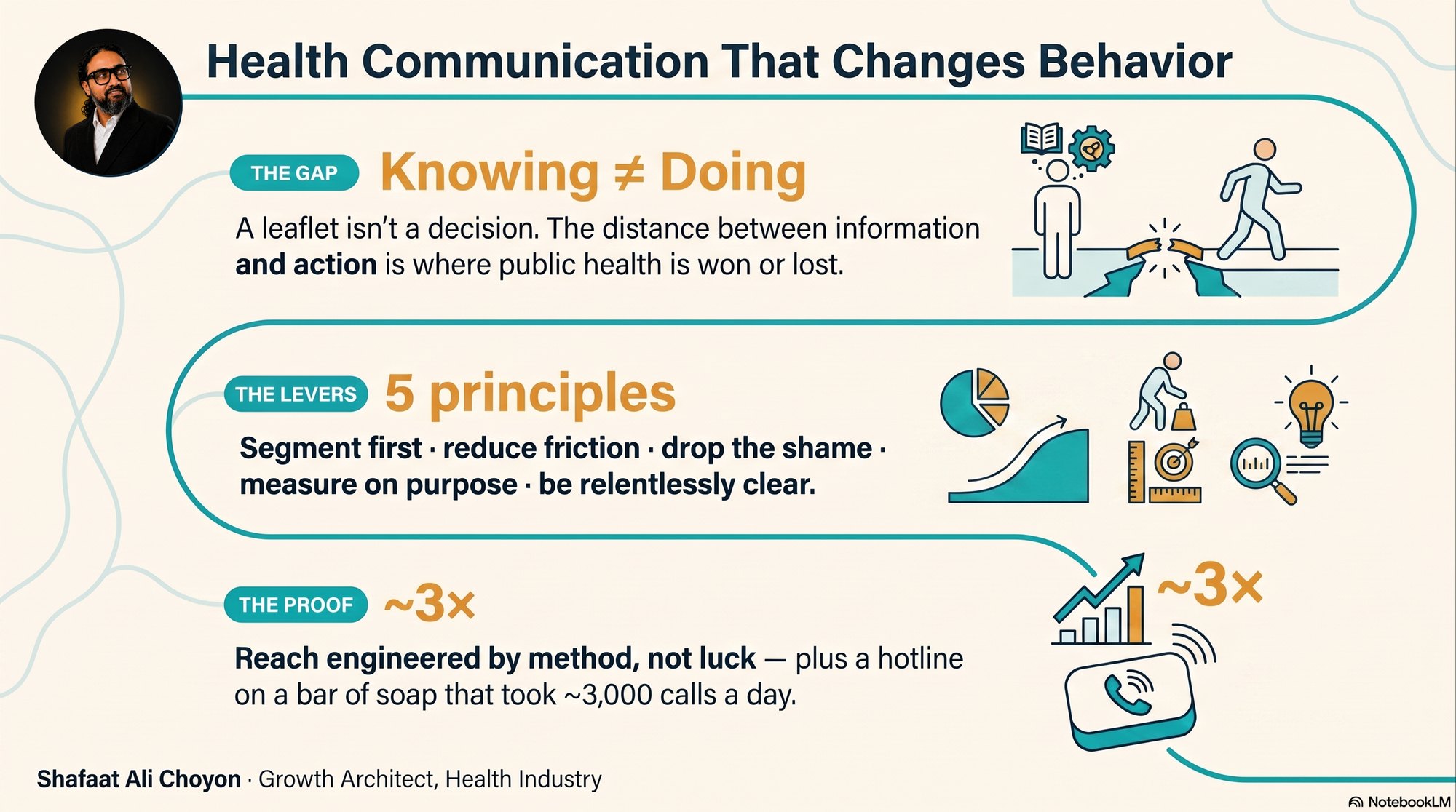
For most of my career, the hardest problem in health has not been the medicine. It has been getting people to act on it. A leaflet is not a decision. A billboard is not a habit. The distance between knowing something and doing something is where public health is won or lost — and closing it is a craft, not a slogan.
Over sixteen years I have designed communication for very different audiences: nationwide consumer campaigns, a healthcare startup reaching people who had never seen a doctor, and university students in Michigan navigating stress and risk. The tools differ every time. The underlying principles rarely do. Here are the ones I keep coming back to.
Meet people on the channels they actually use
Most campaigns broadcast where it is convenient for the sender, not where the audience is listening. That is backwards. When I designed a year-long campus harm-reduction campaign around alcohol and cannabis, the first job was not the message — it was the map. Who are we actually talking to, what shapes their choices, and where do they already spend attention?
We segmented the audience and built for the surfaces they used: social feeds, on-campus digital boards, residence-hall print, and live event touchpoints, each carrying a version of the message tuned to that moment. Segmentation is not a nicety. It is the difference between a message that is technically correct and a message that is actually received.
Remove the friction — don't just raise awareness
Awareness is cheap. Action has a cost, and that cost is usually friction: distance, price, time, embarrassment, uncertainty about what to do next. The most effective health communication I have built worked because it lowered that cost.
At a healthcare company in Bangladesh, we printed a health hotline on the packaging of the market-leading soap and put it in millions of homes. Doctors on the other end took roughly 3,000 calls a day — basic prescriptions over the phone, complex cases referred to the nearest government facility, lab needs routed to sample-collection points. The message and the service were the same object. People did not have to travel to a clinic to start; the clinic came to the thing already in their hand.
Drop the shame
Stigma feels like moral clarity and works like a wall. When a message implies that the audience is careless, dirty, or stupid, the audience stops listening — and often does the opposite to protect their dignity. This is why I lean on a harm-reduction stance: start from where people actually are, not from where we wish they were, and offer a realistic next step instead of a verdict.
On campus, elimination was never a credible goal, and a finger-wagging tone would have backfired. Non-stigmatizing, relevant messages — delivered without judgment — kept students engaged with the information long enough for it to matter. Respect is not a soft skill in health communication. It is a conversion lever.
If you can't measure it, you're guessing
Communication without evaluation is faith. For my MPH capstone, I ran a multi-platform advocacy campaign and refused to leave reach to luck. I locked the analytics methodology up front, reported engagement on two independent measures, and used deliberate stakeholder tagging to extend distribution. The result was a documented, repeatable ~3× amplification — not a lucky post, but a method that could be run again.
Setting the measurement framework before the campaign, not after, is what separates advocacy from noise. It also changes how you write: when you know exactly what you will count, you make sharper choices about what to say.
Clarity is itself an intervention
Confusing health communication is not a neutral failure; it has a price. I have argued this at length in "Mixed Messages, Real Costs" — when guidance contradicts itself, people disengage, delay care, and pay for it later in both health and money. The same logic runs through my writing on health literacy and misinformation: the clearest, most consistent message usually wins, because clarity lowers the effort required to act.
The short version
- Segment first. Map the audience and their channels before you write a word.
- Sell the next step, not the ideal. Reduce friction; make acting easier than not acting.
- Drop the shame. Meet people where they are; respect converts, judgment repels.
- Measure on purpose. Lock the framework before launch so reach is engineered, not hoped for.
- Be relentlessly clear. Consistency and simplicity are health interventions in their own right.
None of this is exotic. It is discipline applied to a human problem: people are busy, skeptical, and moving fast, and a health message has to earn its place in their day. When it does, behavior moves. When it doesn't, no amount of accurate information will save it.
Md Shafaat Ali Choyon (MPH, CHES®, MBA, MCIM) is a growth, marketing and public-health strategist with 16+ years turning complex systems into measurable results. He writes the WellNest Watch column and has published on public health, health communication and health literacy in The Daily Star, The Eastern Echo, Dhaka Tribune and The Financial Express. See the full list of published writing or the portfolio.