I build and run AI in production, so instead of another "AI will change everything" prediction, here's a narrower, more useful one: three bets on where health AI actually lands by 2027 — each grounded in something I've shipped, not just read.
Bet 1: the winners spend on people, not just models
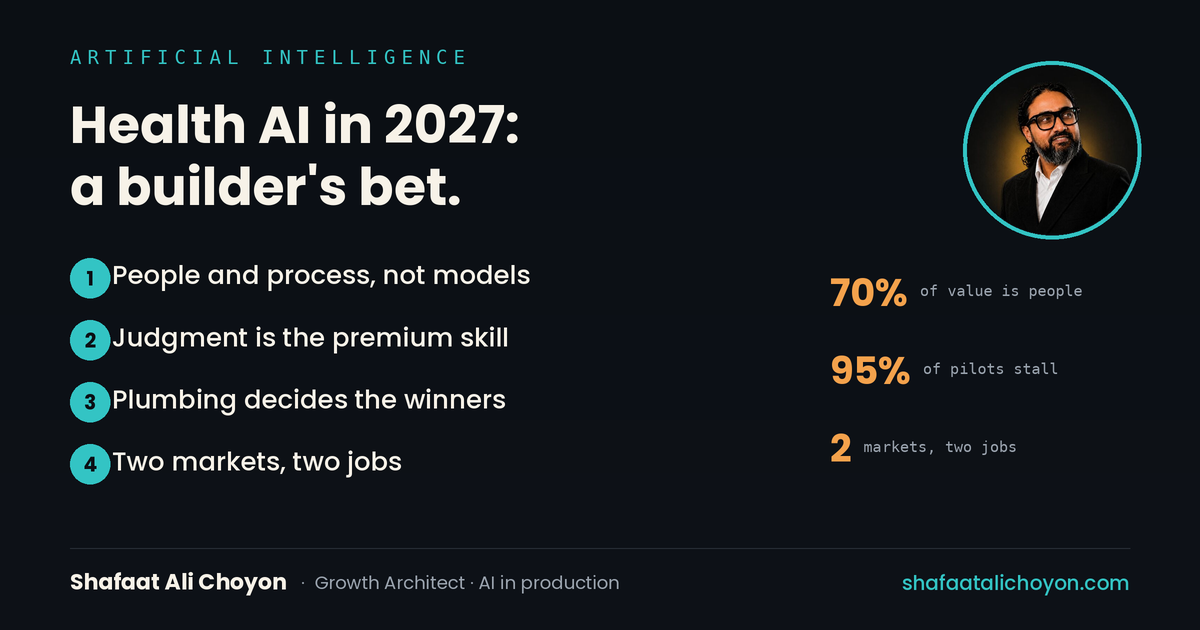
The uncomfortable data from the last two years is that most enterprise AI pilots delivered no measurable return — by one MIT figure, around 95% showed zero P&L impact. Not because the models failed, but because the organizations didn't change around them. Google's own research pins roughly 70% of AI's value on people and process, not the technology. I've lived the smaller version of this: the systems I've shipped worked when I redesigned the workflow and trained the people around the tool, and stalled when I didn't. By 2027 the health systems winning with AI will be the ones that funded the unglamorous 70%.
Bet 2: judgment becomes the premium skill
As models get cheaper and more capable, the scarce skill won't be prompting them. It'll be knowing exactly which parts of a clinical or operational job to hand over and which to keep human. In my own production work the highest-leverage decision is never the prompt — it's drawing the line: automate the repetitive 80%, and defend the 20% where a wrong answer is dangerous or erodes trust. That line-drawing is a discipline, and it's learnable — which means it's teachable, which means it's a moat you can build on purpose.
Bet 3: plumbing decides the winners
The flashiest demo still dies if it can't write to the record, fit the workflow, or clear governance. I learned this the unglamorous way as COO digitizing a multi-entity clinical group at Laser Treat: the wins came from integration and process, and they showed up as +13% patient retention and roughly −$0.5M in operating cost — not from anything that would demo well. Most of the real work in shipping health AI is exactly that: data, integration, and measurement. By 2027 the durable products won't be the smartest; they'll be the best-plumbed.
The dual-market footnote
These bets hold in both my markets, with a twist. In the US the race is capability and integration; in places like Bangladesh it's access and language. Different frontiers — but both reward the team that engineers trust and fit in, rather than bolting cleverness on top. Whoever masters the boring layers wins the market that looks hard and, usually, the one that looks easy too.
The short version
- ~95% of AI pilots showed no return — an organizational failure, not a tech one.
- ~70% of AI's value is people and process; fund the boring 70%.
- The premium skill is judgment about what not to automate.
- Integration and workflow decide winners — I saw it as COO: +13% retention, −$0.5M opex from plumbing, not magic.
In your world, is the bottleneck really the model — or the people, judgment, and plumbing around it?
Md Shafaat Ali Choyon (MPH, CHES®, MBA, MCIM) is a growth, marketing and public-health strategist who builds and runs AI in production, with 16+ years across telecom, fintech, e-commerce, consumer tech and healthcare in the US and Bangladesh. See the essays or the portfolio.