The West has a fashionable new vocabulary for it — "frugal innovation," "constraint-driven design," "doing more with less." In Bangladesh we just called it getting it done. And the closer I look at the celebrated design principles of 2026, the more they turn out to be things scarcity quietly taught us years ago.
Constraint is a design advantage, not a handicap
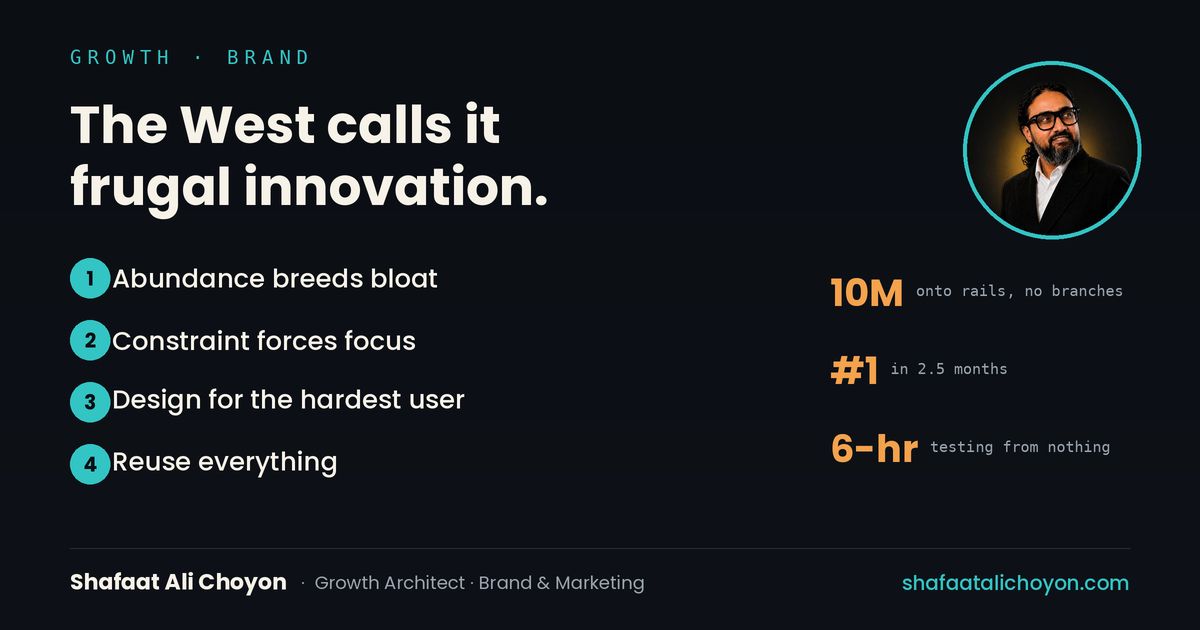
Abundance is a bad teacher. When you have unlimited budget, headcount, and runway, you build bloated things and mistake the bloat for sophistication. Constraint forces the opposite: ruthless focus on what actually matters, because there's no slack to waste. The best design discipline I know didn't come from a studio — it came from having to make something work with a fraction of the resources everyone assumed it required.
I've built under constraint my whole career
This isn't a slogan for me; it's the operating condition of everything I've shipped. When COVID hit and no service existed, we built 6-hour traveler testing from nothing. We turned a bar of soap into a health channel taking ~3,000 calls a day. We put a government stipend onto mobile rails for roughly 10 million people with no bank branches. We took a used-motorbike category to No. 1 in two and a half months. None of it had the luxury of abundance, and all of it worked *because* of the constraint, not despite it.
What scarcity actually teaches
A repeatable philosophy hides inside all of it. Do more with less — treat every resource as if it's your last. Design for the hardest user, and the easy user comes free. Ship before it's perfect, then improve in the real world. And reuse everything — never throw away something that still has value. Those aren't emerging-market compromises; they're the exact principles Silicon Valley now repackages as "lean" and "constraint-driven."
The West is already copying it
Watch the direction of travel. Direct-to-consumer, no-frills, "good enough," radically small teams doing what used to take departments — the frugal playbook is going mainstream in the richest markets precisely as their easy money gets tighter. The places forced to innovate under scarcity aren't behind the curve; they've been standing on the part of it the West is only now reaching. Learn to build as if resources were scarce, and you'll build better even when they aren't.
The short version
- Abundance breeds bloat; constraint forces the focus that good design actually requires.
- I've built under constraint throughout: 6-hour testing, a soap hotline (~3,000/day), ~10M on mobile rails, a category to No. 1 in 2.5 months.
- The philosophy: do more with less, design for the hardest user, ship then improve, reuse everything.
- The West is repackaging it as "lean" and "constraint-driven" — scarcity taught it first.
If your budget were cut to a tenth tomorrow, what would you build instead — and why aren't you building that version now?
Md Shafaat Ali Choyon (MPH, CHES®, MBA, MCIM) is a growth, marketing and public-health strategist who builds and runs AI in production, with 16+ years across telecom, fintech, e-commerce, consumer tech and healthcare in the US and Bangladesh. See the essays or the portfolio.