Walk any startup expo in Dhaka or San Francisco in 2026 and you'll hear the same three words on every booth: "AI-powered." Which means the phrase now communicates nothing. When everyone claims the identical edge, the claim stops being differentiation and becomes wallpaper, and positioning has to move somewhere the copycats can't follow.
Why does positioning on the job beat saying "AI-powered"?
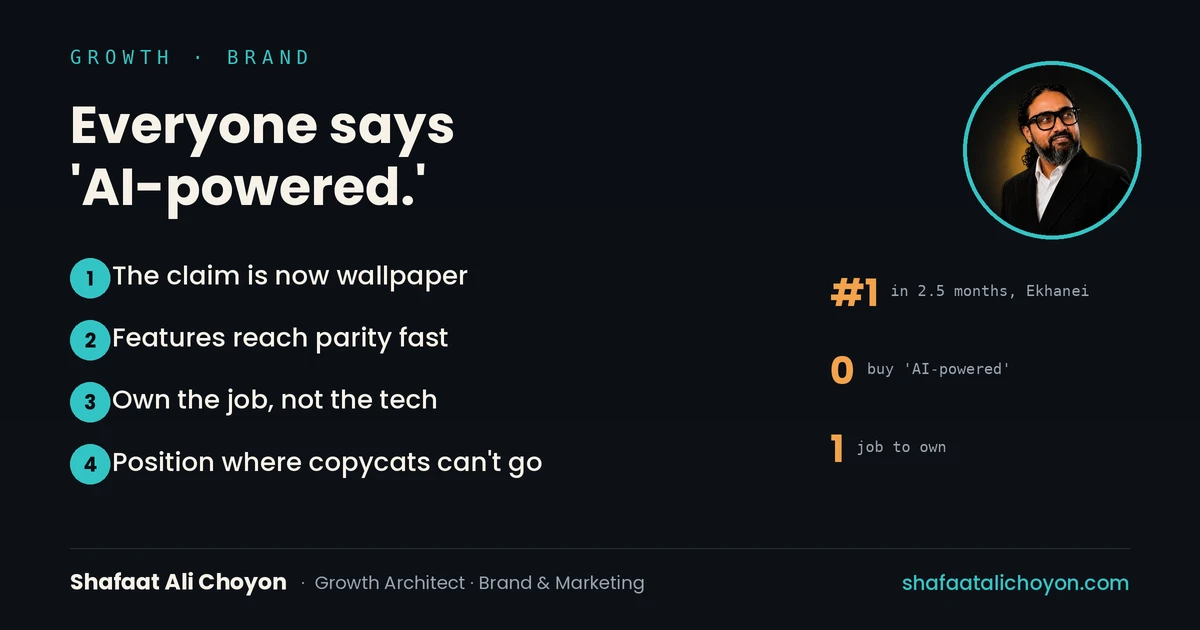
Technology advantages evaporate. The moment "AI-powered" became table stakes, it stopped selling anything, because your competitor's booth says it too. Positioning on a feature is a trap: features reach parity, and then you're left competing on price or noise. The durable ground is somewhere features can't reach, the specific outcome a specific customer is trying to buy.
Position on the job, not the technology
People don't buy AI. They buy an outcome, a job done. I built the motorbike category on Ekhanei to No. 1 in two and a half months, and it wasn't by being the most technically advanced marketplace. It was by owning one clear job: sell your used bike, fast, safely, to a real buyer. Own the job in the customer's head and the technology becomes an implementation detail, yours to talk about only if it makes the job better, never as the pitch itself.
The lesson that predates AI
This isn't new; AI just made it urgent. Launching the Galaxy Note9 to a record-setting result and the J2 to the mass market weren't spec-sheet wins, each phone was positioned around the job its segment was hiring it for: a flagship that signals status, or a dependable phone at a price that works. I saw the same building Asiatic Digital from scratch to roughly $1M in monthly revenue in seven months, it grew by selling the outcome each client actually wanted, not the tooling behind it. Same lesson, three categories: the teams that confuse "what it does technically" with "what it does *for me*" lose, in every decade.
The dual-market note
The trap is identical in both my markets, a Dhaka startup and an SF one making the same undifferentiated "AI-powered" claim into the same indifferent silence. And so is the antidote: pick a job, a segment, an outcome you can own, and let everyone else fight over the adjective. Positioning is one of the few advantages a small team in either market can build faster than a big one.
The short version
- "AI-powered" is now wallpaper, when everyone claims it, it differentiates nothing.
- Features reach parity; positioning on a feature is a trap that ends in price wars.
- Own the job: Ekhanei hit No. 1 in 2.5 months by owning one outcome, not by being most technical.
- It predates AI, Note9 and J2 won on the job each segment was hiring the phone to do.
Strip "AI-powered" off your pitch, what specific job are you unmistakably the best at, in your customer's own words?
Frequently asked questions
Why has "AI-powered" stopped working as a positioning claim?
Walk any startup expo in Dhaka or San Francisco in 2026 and you'll hear the same three words on every booth. When everyone claims the identical edge, the claim stops being differentiation and becomes wallpaper, so positioning has to move somewhere copycats can't follow.
What should companies position on instead of the technology?
The specific job the customer is hiring you to do. I built the motorbike category on Ekhanei to No. 1 in two and a half months not by being the most technically advanced marketplace, but by owning one clear job: sell your used bike, fast, safely, to a real buyer.
Is positioning on the job a new idea created by the AI wave?
No, it predates AI. Launching the Galaxy Note9 to a record-setting result and the J2 to the mass market both won by positioning around the job each segment was hiring the phone to do, not the spec sheet, the same lesson I saw again building Asiatic Digital to roughly $1M in monthly revenue in seven months.
Md Shafaat Ali Choyon (MPH, CHES®, MBA, MCIM) is a growth, marketing and public-health strategist who builds and runs AI in production, with 17 years across telecom, fintech, e-commerce, consumer tech and healthcare in the US and Bangladesh. See the essays or the portfolio.