Everyone in health tech obsesses over the doctor visit — how to book it, stream it, document it. But in most of the world, that's not how a person first touches the system. They start with a test: a fever that won't break, a number their employer wants, a symptom they want explained before they'll pay for a consultation. The lab, not the clinic, is the way in. Build there and you meet people at the exact moment they're ready to act.
Why diagnostics is the natural wedge
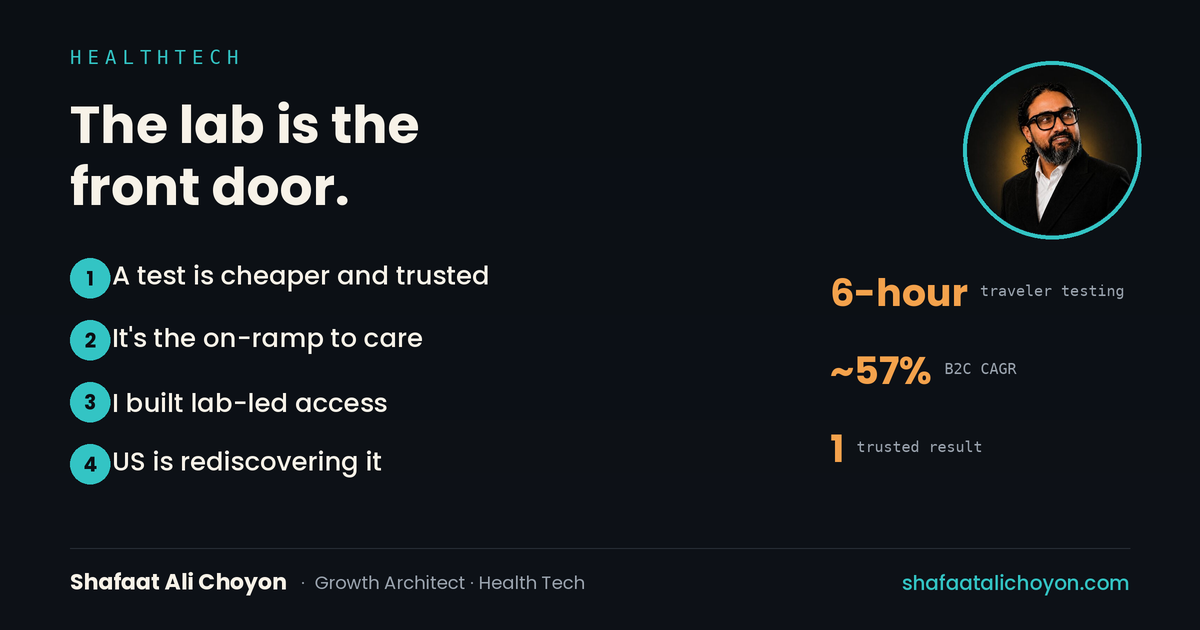
In a cash-pay market, price and trust decide everything, and a test wins on both. It's cheaper than a full consultation, concrete instead of abstract, and it produces a result the patient owns and can act on. That makes diagnostics the lowest-friction, highest-trust way to earn a first relationship — and, done well, the on-ramp to everything else: the follow-up, the prescription, the ongoing care. You don't have to convince someone to commit to a health system. You have to give them one useful result.
I built care that led with the lab
At Praava, diagnostics wasn't a department bolted onto a clinic — it was a wedge into the whole relationship. When COVID hit and no service existed, we stood up 6-hour traveler testing and home sample collection: the lab literally came to the patient. That accuracy-and-access combination is what earned trust, and trust is what compounded into growth — roughly 45% overall and ~57% B2C CAGR over multiple years. None of it started with "see a doctor." It started with "get a reliable answer, fast."
The US is rediscovering this from the other end
Watch where American health is moving: at-home test kits, direct-to-consumer lab panels, pharmacy diagnostics, "know your numbers" screening sold straight to consumers. That's the same insight arriving from the opposite direction — diagnostics as the accessible, patient-owned entry point, unbundled from the traditional visit. Access-scarce markets were forced into lab-led care years ago; abundant ones are now choosing it because patients prefer it.
What builders should take from it
If you're building health anywhere cost-conscious, don't design the clinic first and hope people find the lab. Design the test as the product: fast, transparent, trustworthy, and connected to a clear next step. The result is the hook; the relationship is the business. Lead with the wedge that's cheapest to try and hardest to fake — a number the patient can trust.
The short version
- In cash markets, the first touch is a test, not a consultation — the lab is the real front door.
- Diagnostics wins on price and trust, and becomes the on-ramp to follow-up care.
- I built it: 6-hour traveler testing, home collection, and ~45% / ~57% B2C CAGR at Praava.
- The US is arriving at the same model through at-home and DTC diagnostics.
If you led your health product with a single trustworthy test instead of a doctor visit, how many more people would say yes to the first step?
Md Shafaat Ali Choyon (MPH, CHES®, MBA, MCIM) is a growth, marketing and public-health strategist who builds and runs AI in production, with 16+ years across telecom, fintech, e-commerce, consumer tech and healthcare in the US and Bangladesh. See the essays or the portfolio.