A mosquito is a small thing to build a public-health strategy around, but the Aedes mosquito has quietly become one of the clearest ways to watch climate change turn into a body count. Warmer, wetter, longer seasons expand where it breeds and how long it bites — and the disease it carries, dengue, is now rewriting maps that used to feel settled. This is a health problem, an environmental problem, and a communication problem stacked on top of each other.
The numbers are not slowing down
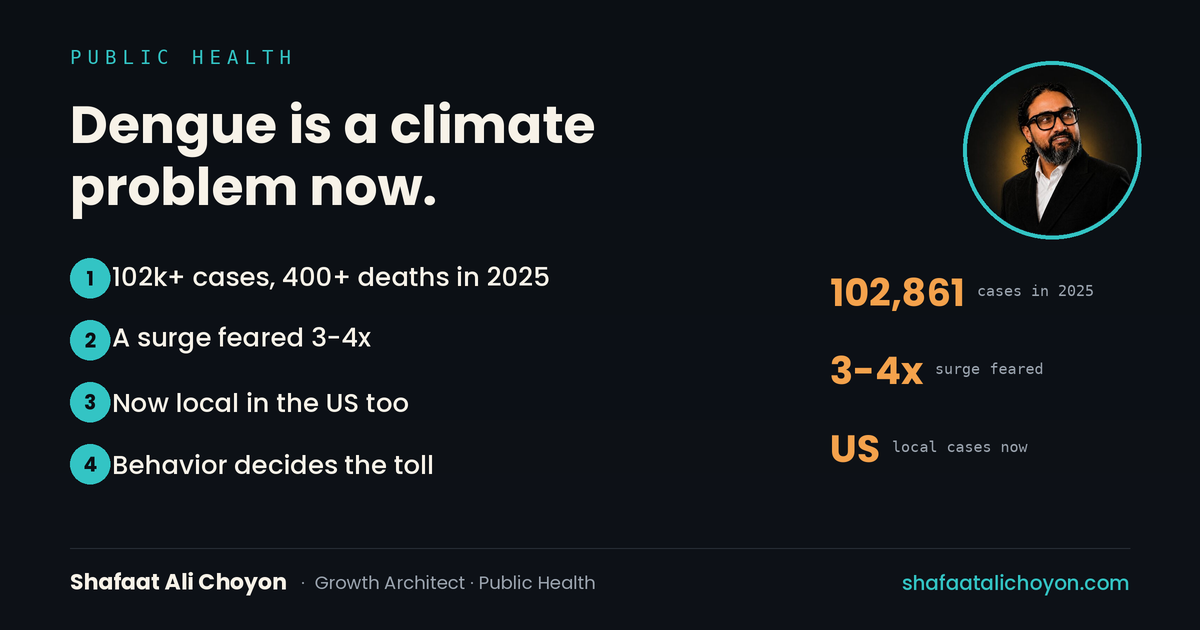
Bangladesh recorded more than 102,000 dengue cases and over 400 deaths in 2025, on top of a similarly brutal 2024. By mid-2026 the count was climbing again, and health officials openly warned that wet weather and thin mosquito control could push infections three to fourfold higher into the peak season. Dengue used to be seasonal and containable. It's becoming chronic and expanding — the epidemiological signature of a warming climate meeting dense, under-drained cities.
It's not only Bangladesh's problem anymore
For decades, richer countries filed dengue under "tropical, elsewhere." That filing is expiring. Locally acquired dengue — transmitted by mosquitoes on home soil, not carried in by travelers — has now appeared in parts of the US, from Florida to Texas to California. The same dynamic as the wildfire smoke and the measles resurgence: a threat the wealthy world assumed it had escaped is arriving at its own door. The US and Bangladesh are, once again, working the same problem from opposite starting points.
The half nobody funds is behavior
You can't vaccinate or spray your way out of dengue alone. A huge share of control is behavioral and local: clearing standing water, protecting the exposed, recognizing warning signs early enough to survive them. That is exactly the unglamorous, hard-to-fund work I've spent a career on — getting people to act on an invisible, intermittent risk. With the Lifebuoy hotline we delivered trusted health guidance through an object already in millions of homes, at roughly 3,000 calls a day; in a year-long campus campaign we moved behavior on a risk people preferred to ignore. Surveillance tells you where the mosquito is winning. Communication is how you actually change what people do about it.
The builder's opening
The hopeful part: this is now a data problem we can attack. Climate and rainfall data, case dashboards, and cheap mobile reach make it possible to predict surges and warn the right neighborhoods before the peak, not after. The missing layer is the same one as always — turning a forecast into trusted, act-now guidance for the people most exposed. That's a dual-market opportunity, and it sits squarely on skills with receipts: surveillance-informed, behavior-first health communication.
The short version
- Bangladesh saw 102,000+ dengue cases and 400+ deaths in 2025; 2026 threatened a three-to-fourfold surge.
- A warming climate is making dengue chronic and expanding its range — including locally acquired cases in the US.
- Control is largely behavioral and local; that's the underfunded half I've built and measured.
- Climate data plus mobile reach make surge-warning tractable — the opening is trusted, act-now guidance.
What slow, invisible risk in your world is quietly going from seasonal to permanent — and who's warning the people in its path?
Md Shafaat Ali Choyon (MPH, CHES®, MBA, MCIM) is a growth, marketing and public-health strategist who builds and runs AI in production, with 16+ years across telecom, fintech, e-commerce, consumer tech and healthcare in the US and Bangladesh. See the essays or the portfolio.