The single most cost-effective health intervention in human history isn't a drug or a device. It's clean water and clean hands. Handwashing alone prevents a staggering share of disease for pennies. And yet, in the richest country and one of the poorest alike, we keep treating the basics as solved and pouring attention into the shiny stuff instead. They are not solved.
Bangladesh: access won, quality still fighting
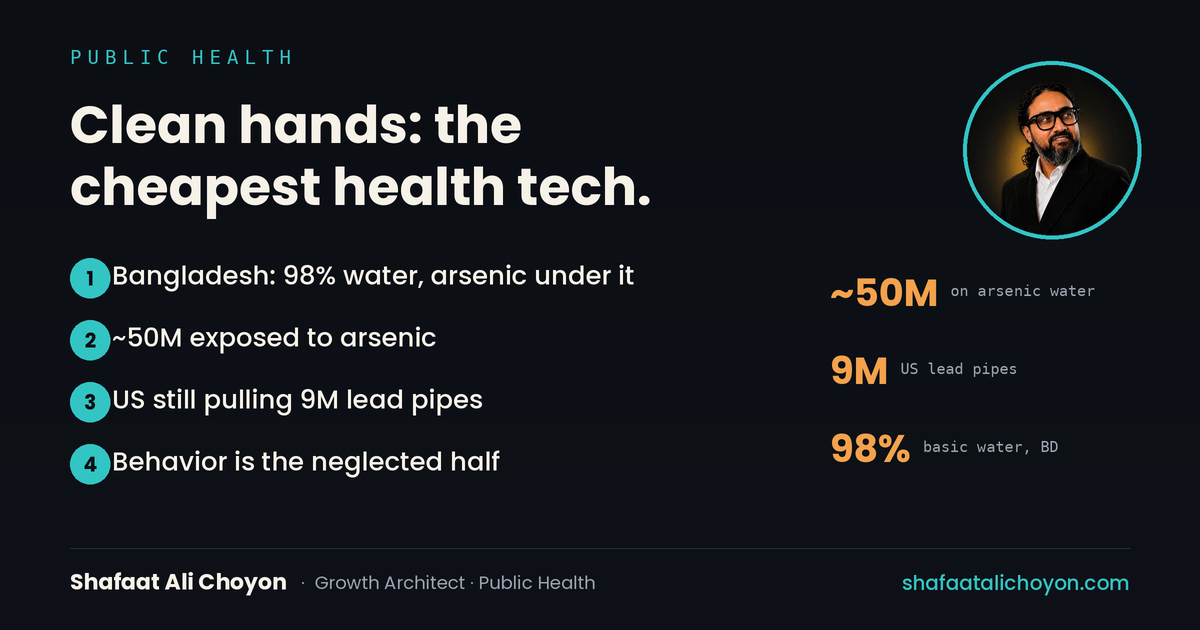
Bangladesh's tubewell revolution pushed basic drinking-water access above 98% — a genuine win that cut cholera and diarrheal disease dramatically. But the same aquifers hide a slower disaster: naturally occurring arsenic exceeds safe limits across roughly 85% of the country's territory, exposing an estimated 50 million people to long-term risk of skin lesions, cancers, and heart disease. Basic sanitation still reaches only about 59%. Access to water was step one; safe water and safe disposal are the unfinished, unglamorous rest.
The US: the basics can decay, too
Anyone who thinks safe water is a "developing-country problem" should look under American streets. The EPA counts roughly 9 million lead service lines still carrying drinking water — enough that a national rule now mandates replacing them within a decade — with lead exposure quietly lowering children's IQ and driving behavioral harm. Flint was not an aberration; it was a preview. Infrastructure isn't built once and forgotten. Left unmaintained, the basics rot, and the poorest neighborhoods drink the consequences first.
The behavior half is the part I've built
Clean water is engineering; clean hands is behavior — and behavior is the half that gets neglected. Getting millions of people to wash at the right moments, consistently, is a communication problem, not a plumbing one. It's exactly the work behind the Lifebuoy handwashing campaigns I've been part of, where the whole challenge was making a hygiene habit stick across millions of households — not informing people that germs exist, but changing what they actually do at the sink, every day, for good. Infrastructure gets the water clean; behavior change gets people to use it well. You need both, and the second one is chronically underfunded.
Tractable, and dual-market
This is deeply tractable and deeply dual-market. Cheap water-quality sensors, arsenic-safe filtration, sanitation entrepreneurship, and habit-forming hygiene campaigns are all buildable now, and the lessons cross borders in both directions — Bangladesh's community hygiene models and America's infrastructure-replacement push are two halves of the same problem. The unsexy truth of public health holds: before the next miracle drug, make sure people can wash their hands with water that won't hurt them.
The short version
- Clean water and handwashing are the highest-ROI health interventions ever — and both markets under-deploy them.
- Bangladesh won water access (98%) but fights arsenic under ~50M people and ~59% sanitation; the US is still pulling ~9M lead pipes.
- Infrastructure decays if unmaintained; the basics are never permanently solved.
- The neglected half is behavior — making hygiene habits stick — which is exactly the campaign work I've built.
What "already solved" basic are you assuming works in your system — and when did anyone last check that it actually does?
Md Shafaat Ali Choyon (MPH, CHES®, MBA, MCIM) is a growth, marketing and public-health strategist who builds and runs AI in production, with 16+ years across telecom, fintech, e-commerce, consumer tech and healthcare in the US and Bangladesh. See the essays or the portfolio.