There's a shop owner in Old Dhaka who runs his entire business off a smartphone — inventory, payments, customers, all of it in Bangla. Last month he tried one of the big AI assistants everyone's talking about. He typed his question the way he speaks. What came back was stiff, half-wrong, and clearly translated from someone else's world. He closed it and went back to a phone call.
That moment is the real state of AI in 2026 — and it isn't a failure story. It's the biggest open opportunity in the field.
The gap nobody's pricing in
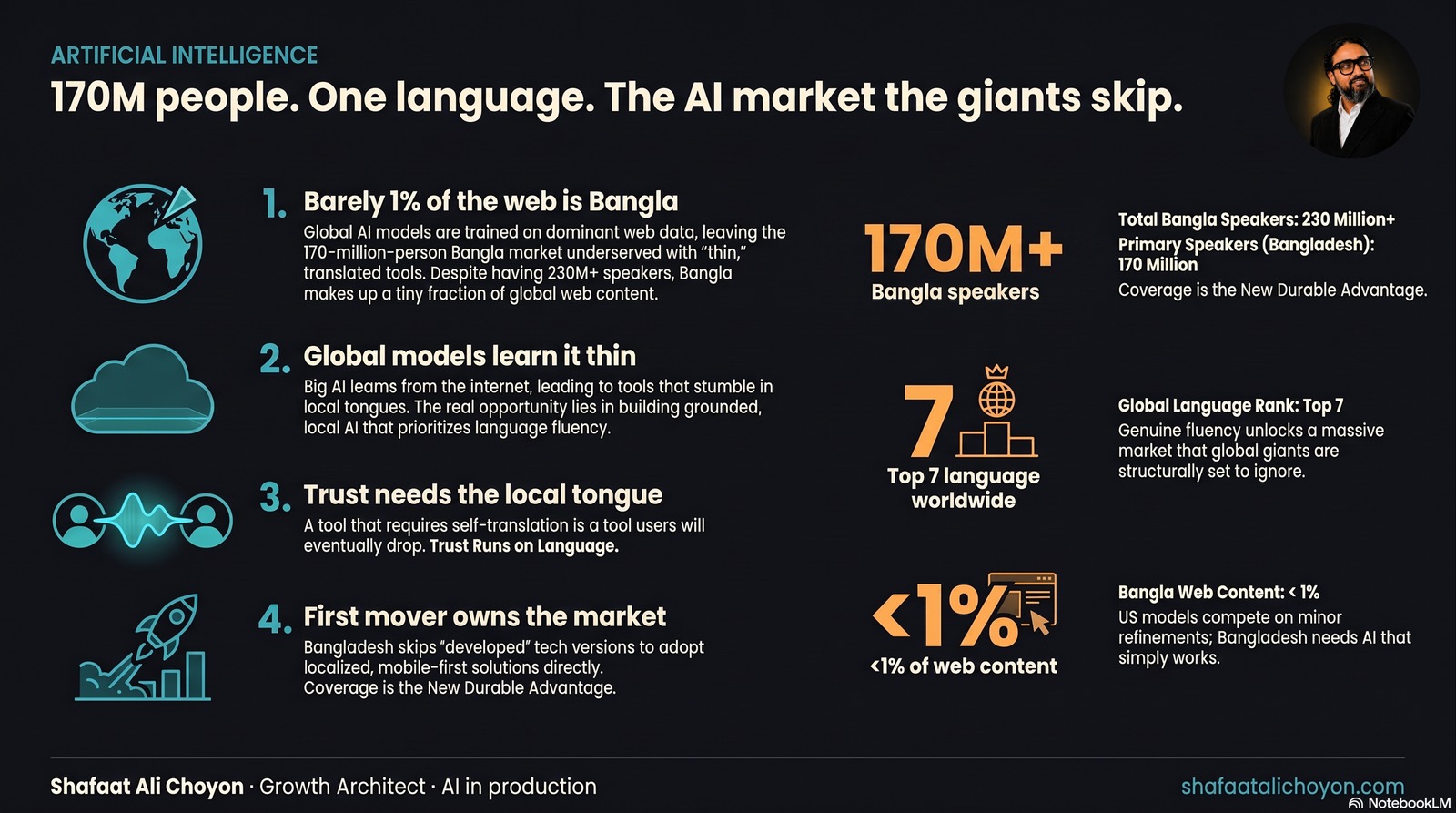
Bengali is spoken by well over 230 million people — one of the seven most-spoken languages on earth, and the first language of more than 170 million people in Bangladesh alone. Yet online it's a rounding error: a fraction of one percent of the world's web content is in Bangla. Large models learn a language from the internet, so they learn Bangla thin. The result is tools that dazzle in English and stumble in the language half a country actually thinks in.
Two markets, opposite frontiers
Most of the AI conversation is happening at the other end of the spectrum. In the US market, models compete over the last five percent of capability — who reasons a notch better, who writes a cleaner paragraph. That's a real race, but it's a race over polish. In a market like Bangladesh, AI isn't competing on polish. It's competing on whether it works in your language at all. Same technology, completely different frontier — and the second frontier is wide open.
Coverage is the next advantage
I build and run AI in production, so I'll say the quiet part plainly: the next durable advantage in AI isn't a bigger model trained on more English. It's coverage. Whoever makes AI genuinely fluent in Bangla — not translated into it, but built for it — unlocks a market of 170 million people that the global giants are structurally set up to ignore. They optimize for the languages that already dominate their training data. That leaves the door open for anyone willing to build for the language that doesn't: grounded in real Bangla sources, trained on local data, with a human in the loop where it counts.
The leapfrog
Bangladesh's own history should make everyone pay attention. This is a country that skipped credit cards and went straight to mobile money. I've shipped that leap: at SureCash we put a government stipend into the hands of roughly 10 million beneficiaries over mobile rails — no branches, no cards, straight to phones — because the country adopts fast when you build for its reality instead of importing someone else's. It didn't wait for the "developed" version of a technology to arrive; it leapfrogged to the version that fit. Bangla-first AI is the same move. The winners here won't be the ones who wait for the big labs to get around to Bangla. They'll be the ones who build local, trustworthy AI now — and earn the trust that only comes from speaking someone's actual language.
Trust runs on language
Trust is the whole game, and trust runs on language. A tool that answers you in your mother tongue, correctly, is a tool you rely on. A tool that makes you translate yourself first is a tool you eventually drop. The US market is relearning this the hard way as AI-generated sameness floods every feed. Bangladesh never forgot it, because its markets were always built on relationships and the local voice.
So the opportunity isn't "AI is failing in the Global South." It's the opposite. The frontier moved, and almost no one is standing on it. 230 million speakers. One language. An AI market the giants keep skipping — right up until someone doesn't.
The short version
- The web barely speaks it. A top-seven world language sits at under one percent of online content.
- Global models learn it thin. Trained on English-heavy data, they translate Bangla instead of understanding it.
- Coverage > capability. The next edge isn't a smarter model — it's one that works in the languages the giants skip.
- Trust needs the local tongue. Answer people correctly in their own language and you become the tool they rely on.
- First mover owns it. Like mobile money over credit cards, Bangla-first AI is a leapfrog waiting for a builder.
Build for the market the giants overlook, and you don't just win a feature — you win a frontier. That's the bet I'd make, in both languages.
Md Shafaat Ali Choyon (MPH, CHES®, MBA, MCIM) is a growth, marketing and public-health strategist who builds and runs AI in production, with 16+ years across telecom, fintech, e-commerce, consumer tech and healthcare in the US and Bangladesh. See the full list of published writing or the portfolio.