For most of my career, marketing's job was to manufacture attention. In 2026 the job has flipped: attention is infinite and nearly worthless, because so much of it is machine-made. The scarce thing now is trust — proof that a real person, with real judgment, stands behind what you're reading. I've spent sixteen years building brands in two very different markets, and both are arriving at the same conclusion from opposite directions.
The backlash nobody priced in
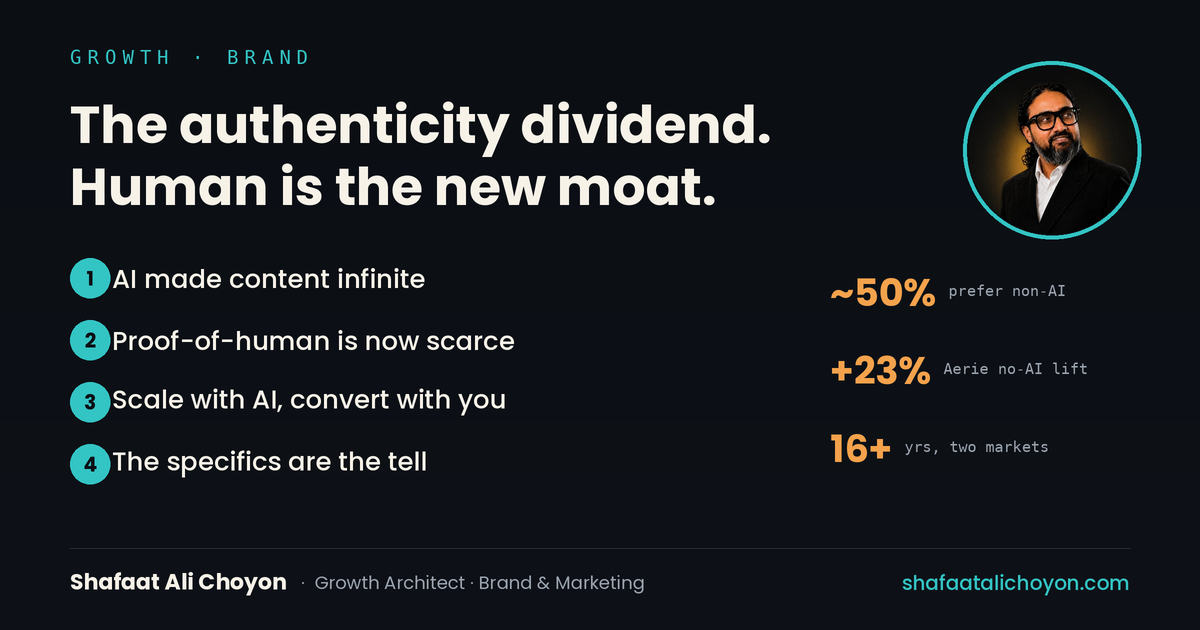
By 2026, roughly half of US consumers say they'd actually prefer brands that *don't* use AI in their customer-facing content. When the retailer Aerie leaned into an explicit real-people, no-AI pledge, it was rewarded with a reported double-digit sales lift. That isn't nostalgia — it's a market correcting. When anyone can generate a polished paragraph or a flawless image in seconds, polish stops signalling effort or credibility. The signal moves to whatever can't be faked: a face, a name, a specific story, a number you can check.
What Dhaka understood first
Here's what US marketers are now relearning — and what I watched work for years. In Bangladesh, a huge share of commerce runs on Facebook pages and WhatsApp threads, "F-commerce," where people buy from a *person*, not a logo. There's no illusion of a faceless brand; there's a seller who answers, a reputation built one reply at a time. When I ran campaigns at Asiatic and grew ACCA's member base, the moves that worked were never the slickest assets. They were the ones that put a credible human in front of a skeptical audience — a named expert taking a real position, a keynote, a testimonial someone would stake their name on.
Use AI to scale, keep the human to convert
I'm not anti-AI — I build and run it in production, and I use it to move faster every single day. The mistake isn't using AI; it's letting it become the voice. The pattern I keep landing on is a division of labor: let AI handle the research, the drafts, the variations, the grunt work — and reserve the parts that carry trust for a person. The hook, the point of view, the face on the post, the claim only you can make. Automate the production; never automate the credibility.
The specifics are the tell
Before anything ships, I run one test: strip the logo off it — could a reader tell a real practitioner wrote this, or could any tool have generated it in ten seconds? Generic is machine-shaped. "We help businesses grow" could have come from anywhere. "I took a used-motorbike category to number one in two and a half months" is human-shaped, because it's checkable and it's mine. In an era of infinite fluent text, specificity is no longer a nice-to-have in copy — it's the proof-of-human that earns the trust the fluent text can't.
Why this compounds
Authenticity isn't a campaign; it's an asset that appreciates. Every real, specific, signed piece you publish makes the next one more believable, because you've built a track record a generator can't borrow. That's true whether you're a solo operator posting on LinkedIn or a brand entering a low-trust category — and it's the same lesson Dhaka's best sellers learned long before "AI slop" had a name.
The short version
- AI made content infinite; it made *proof a human made it* the scarce, valuable thing.
- ~Half of US consumers now prefer brands that avoid AI in their content — the slop backlash is real.
- Bangladesh's relationship-driven markets already run on human trust; they're a preview, not a lag.
- Use AI to scale production; reserve the voice, the POV, and the checkable specifics for a person.
Strip the logo off your last post — could a reader tell a real expert wrote it, or could any tool have made it in ten seconds?
Md Shafaat Ali Choyon (MPH, CHES®, MBA, MCIM) is a growth, marketing and public-health strategist who builds and runs AI in production, with 16+ years across telecom, fintech, e-commerce, consumer tech and healthcare in the US and Bangladesh. See the essays or the portfolio.