The deadliest health threat I've lived closest to isn't a virus or a diagnosis. It's the air. In Dhaka, breathing on a bad winter morning is a measurable assault on the lungs of twenty million people at once — and almost no one is formally accountable for fixing it. That combination, enormous harm and no clear owner, is exactly what makes air quality the most under-worked public-health problem I know.
The numbers are hard to overstate
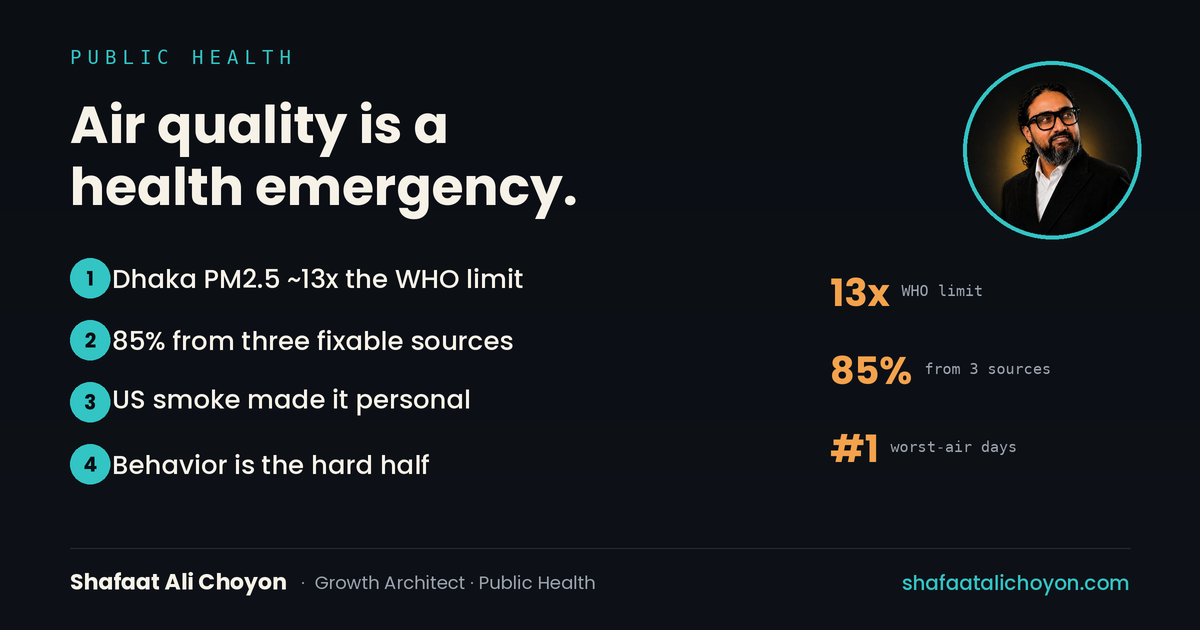
Dhaka's air periodically ranks the single worst in the world, with the Air Quality Index spiking into the "hazardous" range — past 300 — on the worst days. Across 2025 the city's fine-particle pollution averaged around 68 micrograms per cubic meter, roughly 13 times the World Health Organization's guideline of 5, and Bangladesh ranked as the second-most-polluted country on earth. This isn't mysterious. Nearly 85% of it comes from just three sources: brick kilns, road and construction dust, and vehicle exhaust. A problem with three named causes is a problem you can actually design against.
America learned this the hard way too
For years, wealthy countries treated air pollution as someone else's crisis. Then the wildfire smoke came — orange skies over New York, air-quality alerts across whole US regions, millions of people checking an AQI app for the first time in their lives. The lesson landed the way it always does in health: a threat feels abstract until it's in your own lungs. The US and Bangladesh are now, improbably, working the same problem — one from chronic industrial haze, one from climate-driven smoke.
This is a communication problem as much as an engineering one
Cleaner kilns and better transit matter enormously. But I've spent sixteen years on the other half — getting people to change behavior around a health risk they can't see. Invisible, slow, and collective is the hardest possible profile for a health message: no symptom today, no single villain, no obvious action. That is precisely the kind of campaign I've built and measured. For my MPH capstone I locked the measurement framework up front and documented a repeatable ~3× reach; with the Lifebuoy hotline we delivered health guidance through an object people already trusted, at roughly 3,000 calls a day. Air quality needs that discipline: segment who's most exposed, translate an AQI number into one clear action, and deliver it through channels people already use.
The builder's opening
The optimistic read: this is a newly tractable problem. Low-cost sensors, satellite data, and AI now make hyperlocal air data cheap where it was once impossible. The missing layer is the same one it always is — turning that data into trusted, timely, act-on-it-now guidance for the people breathing the worst of it. That's a dual-market opportunity hiding in plain sight, and it's built on skills, measurement and behavior change, I already have receipts for.
The short version
- Dhaka's PM2.5 runs ~13× the WHO limit; the city periodically has the world's worst air, ~85% from three fixable sources.
- US wildfire smoke turned the same invisible threat into a shared, personal one.
- The hard half is behavior and communication around a risk with no symptom and no owner — my core work.
- Cheap sensors and AI make the data tractable; the opening is trusted, act-now guidance.
What invisible risk are the people you serve exposed to daily — and who is actually accountable for helping them act on it?
Md Shafaat Ali Choyon (MPH, CHES®, MBA, MCIM) is a growth, marketing and public-health strategist who builds and runs AI in production, with 16+ years across telecom, fintech, e-commerce, consumer tech and healthcare in the US and Bangladesh. See the essays or the portfolio.