The AI conversation is obsessed with the wrong company. Everyone is watching what Fortune 500s do with AI, the big deployments, the big consultants. The story that will actually move economies is smaller and quieter: a two-person shop in Dhaka now running like a twenty-person one.
The enterprise story is the boring one
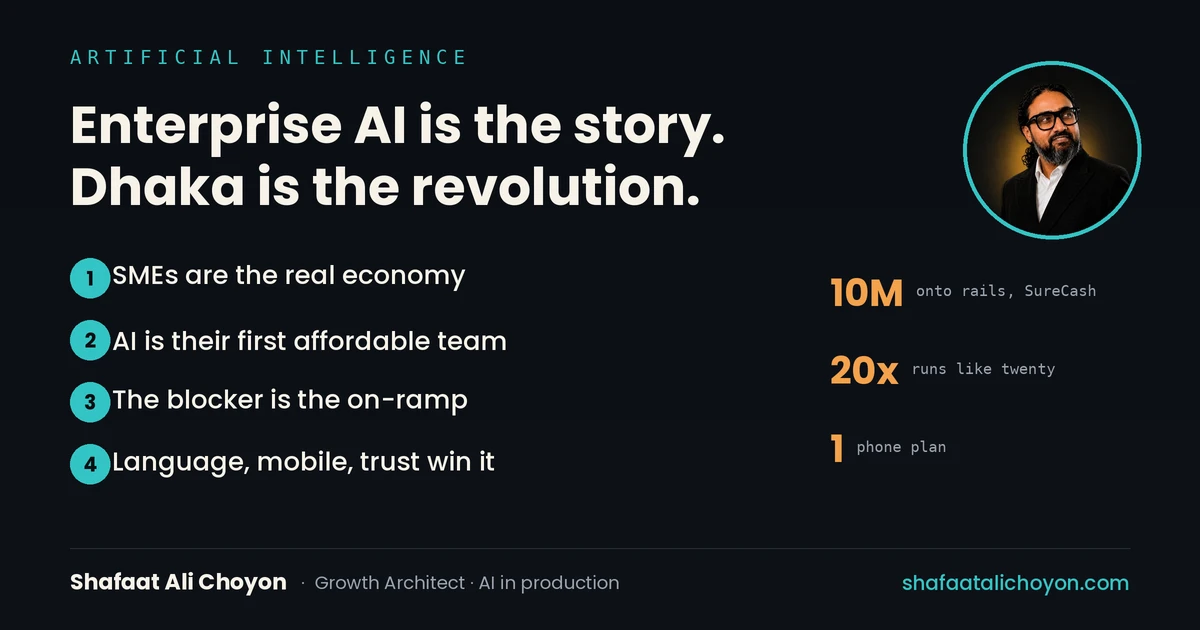
Most economies aren't made of Fortune 500s. They're made of small businesses, and in Bangladesh, SMEs *are* the economy. For a corner retailer or a home-based seller, AI isn't a productivity tweak on top of an already-large team. It's the first affordable "team" they've ever had: a marketer, an analyst, and a copywriter for the price of a phone plan. That's not incremental. That's a different starting line.
I've seen what happens when you give small actors modern rails
This pattern isn't new to me. At SureCash we put digital money into roughly 10 million hands, many of them tiny economic actors who'd never had a bank. The lesson was unambiguous: give small players modern infrastructure and adoption and productivity don't rise, they leap. AI is the next rail. The same micro-entrepreneur who leapfrogged to mobile money is the one about to leapfrog to an AI back office.
The blocker isn't the model: it's the on-ramp
Here's what the giants keep missing. In these markets the constraint was never capability; it's the on-ramp, language, device, and trust. An AI that only works in fluent English, on a fast connection, for someone comfortable with US-shaped tools, doesn't reach the shopkeeper. Build the on-ramp instead, Bangla-first, mobile-first, low-friction, trustworthy, and you unlock tens of millions of micro-businesses the incumbents can't be bothered to serve.
Why the US should be watching
The frugal, SME-first version of AI is a preview, not a sideshow. "AI as a team-in-a-box" is coming for solo founders and small businesses everywhere, and the market forced to build it cheap and inclusive will teach the rest how it's done, exactly as mobile money did before it.
The short version
- The real AI revolution isn't in enterprises; it's in the SMEs that make up most economies.
- For a small business, AI is the first affordable team it has ever had.
- I've seen the pattern: SureCash put ~10M small actors onto modern rails and adoption leapt.
- The blocker is the on-ramp, language, device, trust; whoever builds it unlocks millions.
If AI became a team-in-a-box for the smallest businesses in your market, who reaches them first, and in what language?
Frequently asked questions
Why does a two-person Dhaka business matter more than the enterprise AI story?
Most economies, including Bangladesh's, are made of small businesses, not Fortune 500s. For a corner retailer or home-based seller, AI isn't a productivity tweak on top of an already-large team, it's the first affordable marketer, analyst, and copywriter they've ever had, for the price of a phone plan.
What evidence is there that small actors leap when given modern tools?
At SureCash we put digital money into roughly 10 million hands, many of them tiny economic actors who'd never had a bank. Giving small players modern infrastructure didn't produce incremental gains, adoption and productivity leapt.
What's actually blocking AI adoption for small businesses, if not capability?
The on-ramp: language, device, and trust. An AI that only works in fluent English on a fast connection doesn't reach the shopkeeper. Building it Bangla-first, mobile-first, and low-friction is what unlocks tens of millions of micro-businesses.
Md Shafaat Ali Choyon (MPH, CHES®, MBA, MCIM) is a growth, marketing and public-health strategist who builds and runs AI in production, with 17 years across telecom, fintech, e-commerce, consumer tech and healthcare in the US and Bangladesh. See the essays or the portfolio.