For most of my career, ambition was rationed by headcount. If you wanted to run research, content, design, outreach and analytics at once, you needed a team. In 2026 I run all of it myself, because agentic AI quietly removed that ceiling — and the experience has taught me something more interesting than "AI makes you faster."
The ceiling that just disappeared
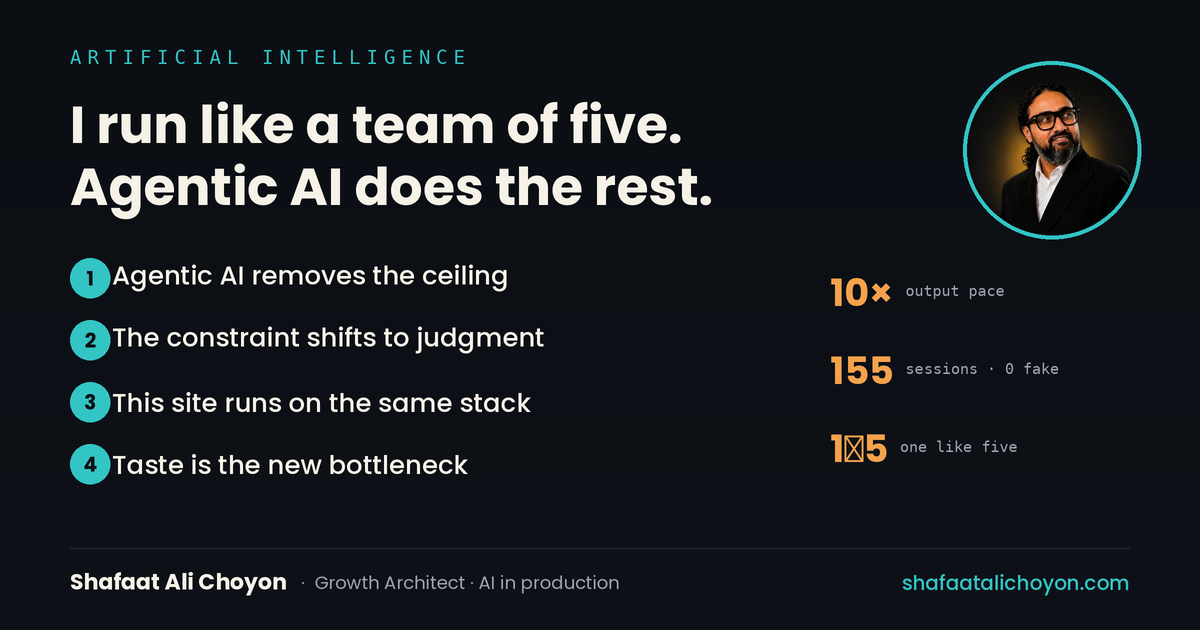
A single operator used to hit a hard wall: there are only so many hours, and context-switching between five jobs destroys the quality of all five. Agentic AI breaks that wall by holding the context for you — running the research while you write, drafting the variations while you decide, keeping the threads warm so switching costs collapse. I've watched my own throughput move by something like 10× on the work that used to bottleneck me. Not because I type faster, but because I no longer do the parts that were never the point.
I ran the experiment on myself
This isn't theory. I built an AI operating layer around my own job search and content — a system that researches roles, drafts tailored materials, and manages the pipeline — and ran it across 155 sessions with zero fabricated facts, because I engineered verification in rather than trusting output blindly. This very website runs through the same discipline. I'm not describing a demo; I'm describing the way I work every day, as someone who builds and ships AI in production.
The bottleneck moved — it didn't vanish
Here's the part the hype misses. When production gets cheap, the scarce resource isn't effort anymore — it's taste and judgment. What to say, which angle is true, which draft is honest, where a wrong answer is dangerous. The machine can generate a hundred versions; deciding which one deserves your name is still entirely on you, and it's harder now, not easier, because there's more to choose from. The operators who win this era aren't the ones who prompt best. They're the ones with the judgment to point all that capacity at the right thing.
Why this is bigger outside Silicon Valley
The US frames agentic AI as an enterprise story — big companies deploying big systems. The more radical version is a two-person business in Dhaka running like a twenty-person one, on the same tools, at a fraction of the cost. In markets where capital is scarce and talent is stretched, the leverage is enormous: agentic AI is the closest thing to hiring a team that a bootstrapped founder has ever had. The gap between "idea" and "operating company" just narrowed most for the people with the least.
The short version
- Agentic AI removes the old headcount ceiling on what one operator can run.
- I proved it on myself: ~10× output, an AI operating layer across 155 sessions, zero fabricated facts.
- When production gets cheap, judgment and taste become the scarce, decisive skill.
- The biggest leverage isn't in US enterprises — it's a solo founder in Dhaka running like a team.
If production stopped being your constraint tomorrow, would your judgment be sharp enough to use all that capacity well?
Md Shafaat Ali Choyon (MPH, CHES®, MBA, MCIM) is a growth, marketing and public-health strategist who builds and runs AI in production, with 16+ years across telecom, fintech, e-commerce, consumer tech and healthcare in the US and Bangladesh. See the essays or the portfolio.